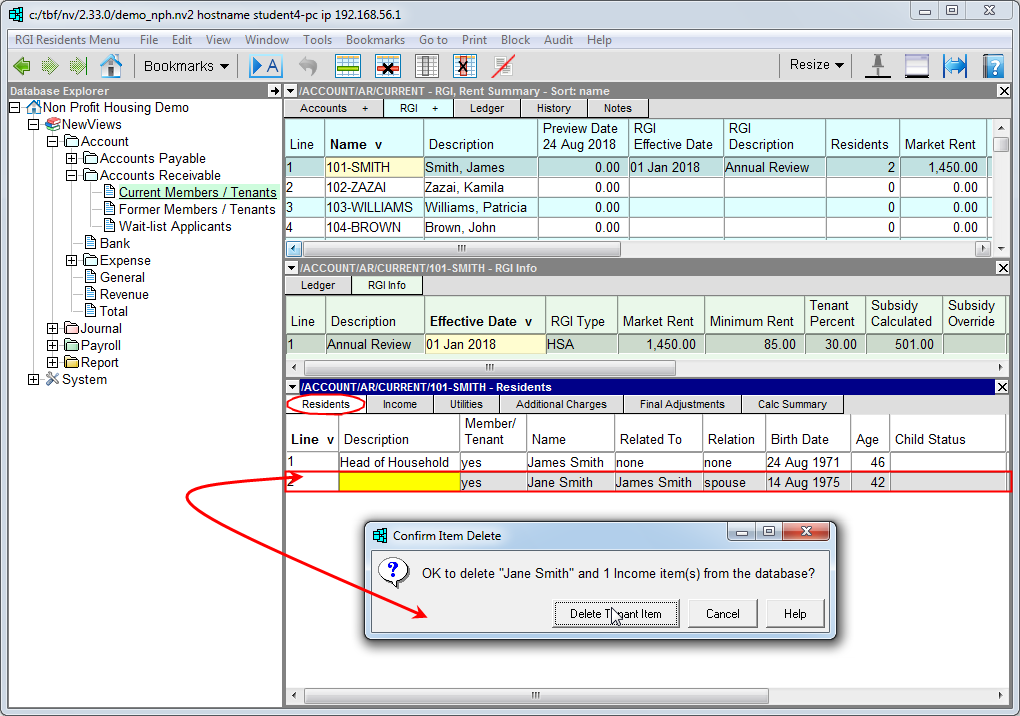
In the Database Explorer, activate (click on) Current Members/Tenants.
Current Members/Tenants can be found by expanding the following folders: NewViews/Account/Accounts Receivable
Make sure you are on the Rent Summary view.
This view summarizes information that is entered in the RGI Info table.
/ACCOUNT/AR/CURRENT - RGI, Rent Summary should be displayed in the title bar across the top of the window. If you are not on the Rent Summary view, click the RGI + tab below the title bar to select it.
Position on the member/tenant account for which the subsidy is to be calculated, then click the RGI Info tab in the middle pane.
Note: If no middle pane is displayed, double click the account in the top pane to display the detail panes.
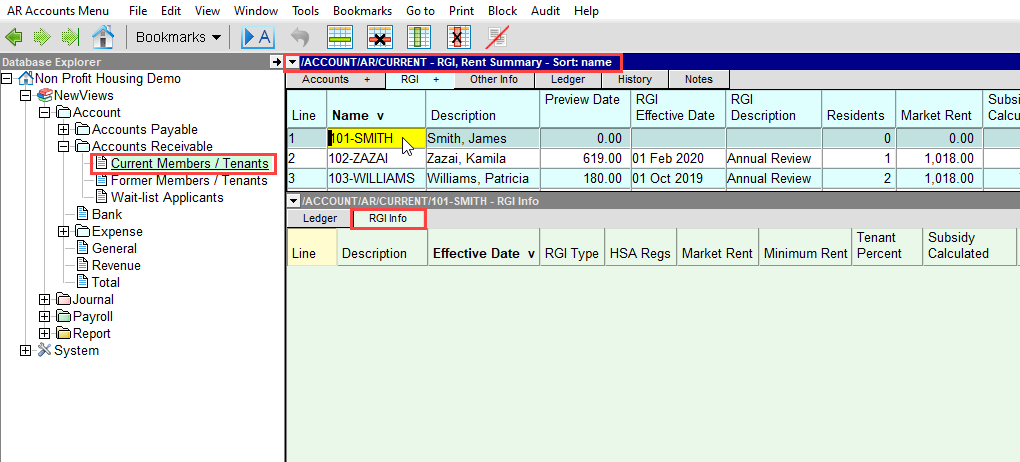
Click anywhere in the RGI Info table, then use the Edit>Append command or press <Ins> to add an item.
Enter a Description, Effective Date, RGI Type (HSA, ILM, Section 95, FCHI2), HSA Regs (Ontario Regulation 298/01 or 316/19) and Market Rent value for the unit (see the example below).
Note: You can press F3 to choose the RGI Type and HSA Regs from a list.
Note: By default, the minimum rent value under HSA Regulations in Ontario is 129.00 for new tenants. You can override this default by entering a new value in the Minimum Rent field.
Note: By default, the RGI calculator uses 30% for the tenant contribution. If a different percentage is to be used for the calculation, enter it in the Tenant Percent field.

Click the Residents tab in the bottom window (3rd pane). If the third pane is not visible, double click the RGI entry to open it.
Note: As soon as you click the Residents tab, the RGI item you have just created is saved. This causes the RGI calculator to perform a preliminary calculation without any information for household composition, income, etc. This calculation will automatically be updated as you enter these details.
The table shown in the Residents tab depends on the RGI type. If you are using HSA, it also depends on whether you are using Regulation 316/19 or 298/01 for the RGI calculation. The examples below show the differences in the Residents tab for HSA Regulation 316/19 vs Regulation 298/01. Specifically, the Child Status and Paid Child Support fields are not used to calculate RGI under Ontario Regulation 316/19.
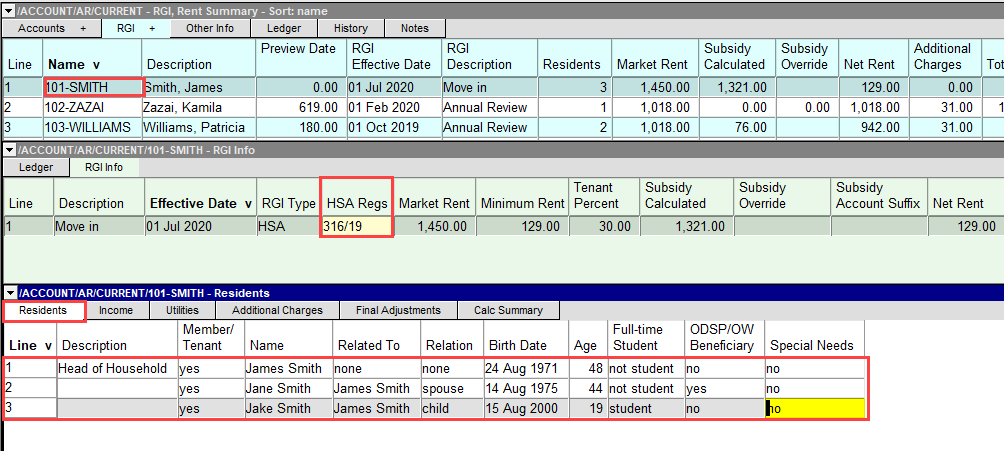
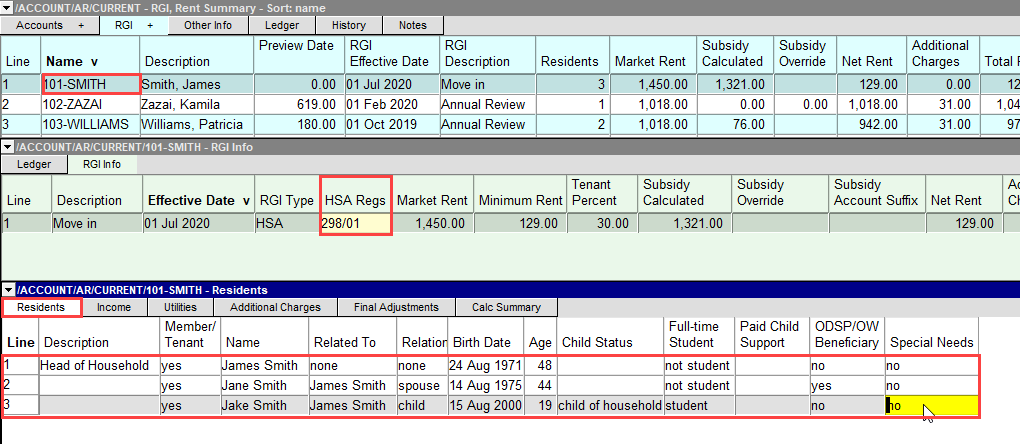
Use the Edit>Append command or press <Ins> to add an item. Use the chart below as a guide to enter the information for the first member of the household (generally the head of the household).
| Description | This field can be used to identify the head of household (family/benefit unit) or to describe the relationship of one resident in the household to another (i.e. a relationship that is helpful to know, but not meaningful for subsidy calculations, e.g. grandmother or brother). |
| Member/Tenant | Is this person a member of the co-op or tenant of the building. |
| Name | Name of resident. |
| Related to | Press <F3> to pick from a list of residents, or none. Choose none for heads of family/benefit units. For all other residents, pick the appropriate head of the family/benefit unit. |
| Relation | Press <F3> to specify the relation of the resident to the head of the family/benefit unit. Choose none for heads of family/benefit units. For all other residents, pick spouse or child (i.e. their relationship to the head of the family/benefit unit). |
| Birth Date | Enter the resident's birth date in this field. |
| Age | The resident's age is calculated and displayed in this field. |
| Child Status (HSA Ontario Reg 298/01, ILM and Section 95 only) | If a child has never lived on his/her own, has never married and is not a parent of a child living in the household, press <F3> and choose child of household. Otherwise, leave this field blank. |
| Full-time Student | If the resident is a full-time student, press <F3> and choose student. Otherwise, choose not student. |
| Paid Child Support (HSA Ontario Reg 298/01, ILM and Section 95 only) | If the resident pays child support for a child not living in the household, enter the amount of child support paid monthly in this field. |
| ODSP/OW Beneficiary (does not appear if HSA type is FCHI2) | Is this person a beneficiary of an ODSP or OW benefits plan (yes/no)? |
| Special Needs | Is this person special needs (yes/no)? |
Use the Edit>Append command or press <Ins> to add the next resident to the table as described above.
Repeat this process for all residents of the household.
Once all the residents of the household have been added on the Residents tab, click the Income tab.
Use the Edit>Append command or press <Ins> to add an item. Use the chart below as a guide to enter the first source of income for the household.
Note: The types of income that can be specified in the Income Type field depends on the RGI type. If you are using HSA, it also depends on whether you are using Regulation 316/19 or 298/01 for the RGI calculation. The examples below show the differences in the Income tab for HSA Regulation 316/19 vs Regulation 298/01


| Description | This field can be used to add any useful comments regarding the resident's source of income. |
| Name | Press <F3> to choose from a list of household residents. |
| Income Type under Ont Reg 316/19 | Press <F3> to choose Net Income w/Employment if the resident's net income comes from any of the following sources: wages, salary, commission, bonuses, tips or gratuities, vacation pay, remuneration as a dependant contractor, income from work in a business the resident operates or controls directly or indirectly, EI benefits, WSIB payments, payments for sick leave or short-term disability under a private or workplace insurance plan, any other income the service manager determines is related to employment. If the resident's net income does not include any of the sources listed above, choose Net Income. If any of the resident's income comes from CPP-D, an OAS Spouse's Allowance, ODSP, OW or RDSP, these need to be added as separate items in addition to Net Income w/Employment or Net Income, as these amounts are factored into the RGI calculation. Note: Amounts entered for Net Income w/Employment or Net Income are generally annual amounts taken from line 23600 of the resident's Notice of Assessment from the CRA. |
| Income Type under Ont Reg 298/01, ILM and Section 95 | Press <F3> to choose from a list of income sources: Assets, Child Support Income, CPP-D, EI, OAS, ODSP, Other Income, OW, Pensions, Regular Employment, Self Employment, WSIB |
| Income Type under FCHI2 | Press <F3> to choose from a list of income sources: Employment Income, Investment Income, Other Income, Social Assistance |
| Income Amount | Enter the income amount per pay period. |
| Pay Period | Press <F3> to choose from a list of pay periods: daily, weekly, bi-weekly, monthly, semi-monthly, annual |
| ODSP Info (does not appear when RGI Type is Section95 or FCHI2) | If the resident receives ODSP income, press <F3> to specify the type: Single (1 disability), Couple (1 disability), Couple (2 disabilities) |
| ODSP/OW Shelter (Section95 only) or Shelter Amount (FCHI2 only) | Enter the shelter component of the social assistance amount received by the resident. |
For RGI calculations using Ont Reg 298/01: If a resident's income fluctuates from pay period to pay period, you have the option of using the Income Detail window to calculate the average income per pay period.
-
Fill in the Name, Income Type and Pay Period for the income item, leaving the Income Amount field blank.
-
Double click the income item to display the Income Detail pane.
-
Add an item with an amount for each of the last six pay stubs. NewViews will automatically calculate the average income for the pay period and enter it in the Income Amount field in the pane above.

Use the Edit>Append command or press <Ins> to add the next source of income as described above.
Repeat this process for all sources of income for the household.

Once all sources of income have been added on the Income tab, click the Utilities tab.
Use the chart below as a guide to enter the details for household utilities. Note that the fields that are displayed depend on the RGI type.
| Number of Bedrooms (HSA only) | Press <F3> to choose the number of bedrooms: 1, 2, 3, 4+ |
| Household Layout (ILM, Section 95 and FCHI2 only) | Press <F3> to select: Apartment, Bachelor Apartment, 1 bedroom Apartment, 2 bedrooms Apartment, 3 bedrooms Apartment, 4 bedrooms Row house, 1 bedroom Row house, 2 bedrooms Row house, 3 bedrooms Row house, 4 bedrooms Row house, 5 bedrooms Stacked, 1 bedroom Stacked, 2 bedrooms Stacked, 3 bedrooms Stacked, 4 bedrooms Stacked, 5 bedrooms S.F. Detached (with basement), 1 bed S.F. Detached (with basement), 2 beds S.F. Detached (with basement), 3 beds S.F. Detached (with basement), 4 beds S.F. Detached (with basement), 5 beds S.F. Detached (with basement), 6 beds |
| Pays Electricity Bills | Type y or n, or press <F3> to choose yes or no. Note: If Pays Electricity Bills is set to yes, Laundry Facilities Provided must be left blank. |
| Laundry Facilities Provided (HSA, ILM and Section95 only) | Press <F3> to select: none, building, unit_washer_only, unit_dryer_only, unit_washer_dryer Laundry facilities must be specified if the Pays Electricity Bills is set to no. |
| Pays to Heat Water | Type y or n, or press <F3> to choose yes or no. Note: If Pays to Heat Water is set to yes, Rents a Hot Water Heater (not displayed for FCHI2) and Water Heater Energy Source must be specified. |
| Rents a Hot Water Heater (not displayed for FCHI2) | Type y or n, or press <F3> to choose yes or no. |
| Water Heater Energy Source | Press <F3> to select: oil, gas, electricity |
| Pays for Non-hot Water (HSA only) | Type y or n, or press <F3> to choose yes or no. |
| Supplies their own Fridge/Stove (not displayed for FCHI2) | Press <F3> to select: fridge, stove, both, neither |
| Pays Heating Bills | Type y or n, or press <F3> to choose yes or no. Note: If Pays Heating Bills is set to yes, the Heating Energy Source, Household Layout and Provincial Zone (not displayed for FCHI2) must be specified. |
| Heating Energy Source | Press <F3> to select: oil, gas, electricity |
| Household Layout (HSA only) | Press <F3> to select: Apartment, 1 bedroom Apartment, 2 bedroom Apartment, 3+ bedroom Row house Semi-detached house Single detached house |
| Provincial Zone (not displayed for FCHI2) | Press <F3> to select: Southern, Central, North Eastern (HSA only), Northern, Eastern (ILM and Section95 only), North Western (ILM and Section95 only) |
| Utilities Override | Any value that is entered here will override the utility subsidy that is calculated by the RGI calculator. |

Once all the details for household utilities have been entered on the Utilities tab, click the Additional Charges tab.
Use the Edit>Append command or press <Ins> to add an item.
Enter a description (e.g. parking or sector support) and amount for the additional charge.
Note: You can use the description field to keep track of parking spaces, e.g. designated parking space(s), permit numbers and/or license plates.
In the Account field, press <F3> to choose the appropriate revenue account from a select box. See Select Boxes for more information on choosing accounts.
If there are other charges for the household, use the Edit>Append command or press <Ins> to add an item for each charge and fill in the fields as described above.

Note: Additional charges are not factored into subsidy calculations, but are added to net rent when rent roll transactions are created automatically.
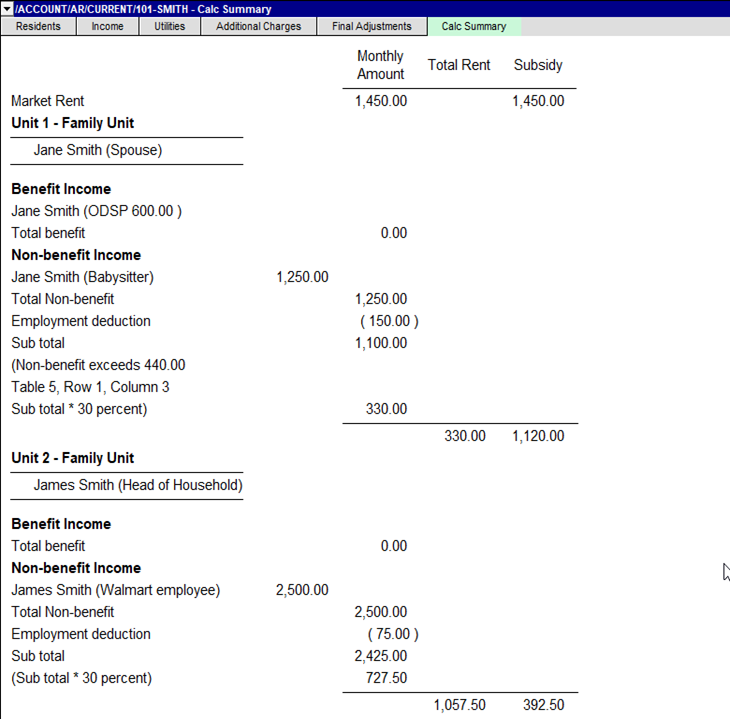
Once all the details needed to calculate the subsidy have been entered on the Residents, Income, Utilities and Additional Charges tabs, the calculation can be viewed and/or printed by clicking the Calc Summary tab.
Note: The results displayed in the Calc Summary tab depend on the RGI type. For HSA, the calculation summary also depends on whether you are using Ontario Regulation 316/19 or 298/01 for the RGI calculation.
Example of RGI calculation summary using Ont Reg 316/19:

Example of RGI calculation summary using Ont Reg 298/01:
Use the Print command to display the calculation in your default browser. You can then print the page by accessing the browser menu and choosing the print option.