Traditionally in accounting, transactions are recorded in journals and then posted to account ledgers. For this reason, journals are often called books of original entry, and account ledgers are called books of final entry. However, there is an overwhelming reason why journals should be used; it is often necessary or convenient to concentrate information for a particular type of transaction in one place. For example, a sales journal is especially useful for keeping customer invoices in one list, where individual invoices can be looked up by invoice number.
In NV2, transactions can be added to ledgers via journals, or directly to the account ledgers themselves. When you add a transaction to an account ledger, NV2 automatically records the entry in the specified journal. The end result is identical, regardless of where the transaction is actually added. Any given transaction can also be edited on the account ledger or in the journal. In this way, you have the convenience of posting directly to accounts, and the benefit of having all transactions organized in journals.
NV2 has six (6) journal types, each of which has a specific purpose. The 6 types of journal are Bank Deposit, Bank Payment, General, Payroll, Purchase & Sales.
In the example below, we are looking at a Bank Payment journal. The active transaction is a payment for 10,000.00, issued from bank account 1060 for dividends, dated January 31, 2013.
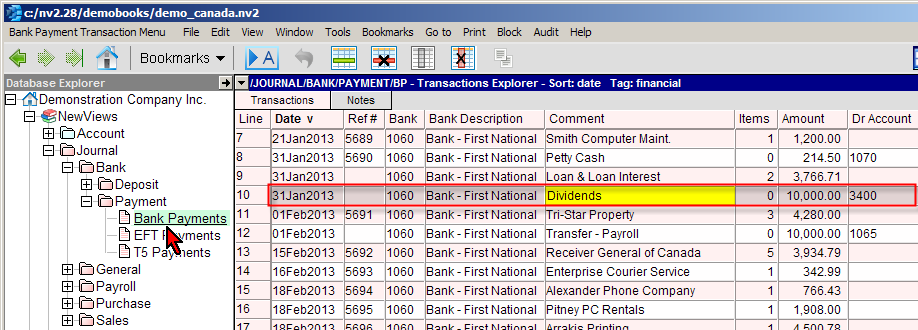
This is a simple journal entry, affecting two accounts (bank account 1060 is credited and expense account 3400 is debited). We can go directly from the debit or credit side of a journal entry to the corresponding posting in the account ledger by using <F9>, the Go to>Account command.
NOTE: To use the <F9> feature, you must be positioned on the account name field before you press <F9> so NV2 knows which side of the details you wish to look at.
See Journals for more.